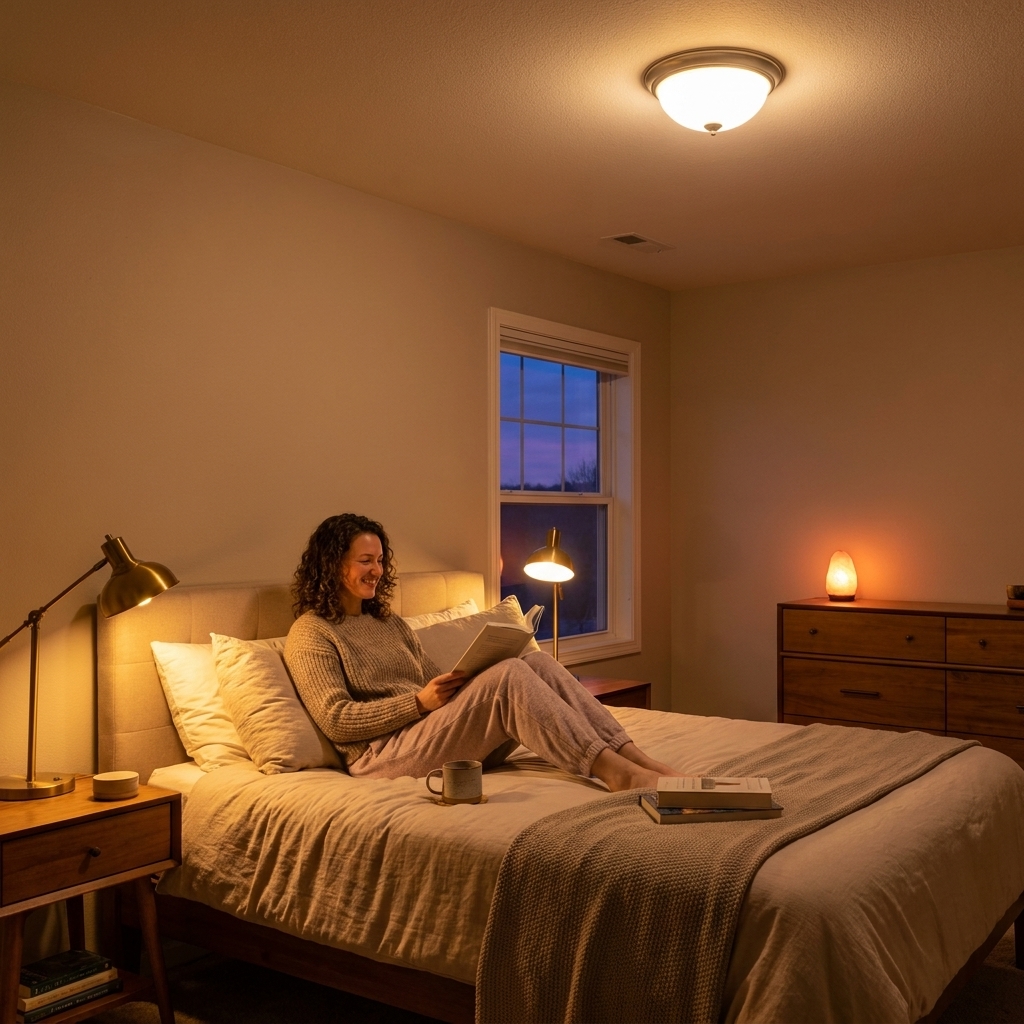
A statement chandelier in a master bedroom is one of those rare upgrades that makes the whole room feel styled, even if your nightstands are thrift finds and your dresser is from three apartments ago. The trick is getting the scale and hanging height right so it feels dreamy, not like you installed a ballroom fixture over your pillow.
Below is the sizing process I use when I help friends swap a builder-grade dome light for something with personality, without bonking heads or visually shrinking the room.

Before you shop: pick the job
In bedrooms, chandeliers are usually about mood, not task lighting. You want sparkle, shape, and presence, while your bedside lamps do the heavy lifting for reading.
- Over-the-bed centerpiece: the chandelier becomes the visual anchor, centered on the bed.
- Room center: the chandelier is centered in the room for overall balance, best when the bed is off-center or you have a seating area.
- Foot-of-bed glow: the chandelier hangs closer to the foot of the bed or in front of a dresser, great when you want drama but not directly above where you sleep.
Decide this first, because placement changes how big you can go and where the hanging height needs to land.
Step 1: Measure the room
Grab a tape measure and write down three numbers:
- Room width (wall to wall)
- Room length (wall to wall)
- Ceiling height (floor to ceiling)
If your bed is the star, also measure:
- Bed width (twin, full, queen, king)
- Headboard height (if you have one)
Quick bed width reference (approximate):
- Twin: 38 inches
- Full: 54 inches
- Queen: 60 inches
- King: 76 inches
Step 2: Pick the diameter
There are two solid ways to land on the right width. Think of both as starting points, then adjust based on ceiling height, how visually “heavy” the fixture is, and the clearances you need.
Option A: Room formula (best for room center)
Add your room length and width in feet. Use that total as a starting chandelier diameter in inches.
Diameter (inches) ≈ Room length (feet) + Room width (feet)
Example: A 12 foot by 14 foot bedroom
12 + 14 = 26 so start by looking for a chandelier around 26 inches wide.
If that number feels too bold for a bedroom, scale down a few inches, especially if the fixture is chunky, opaque, or has lots of visual mass.
Option B: Bed formula (best for over the bed)
This one keeps the chandelier from overpowering the bed, which is what most people mean when something looks “too big” in a bedroom.
- Choose a chandelier that is about one-third to one-half the width of the bed.
- Keep at least 6 to 12 inches of breathing room between the chandelier’s widest point and the edges of the bed on each side.
Examples:
- Queen bed (60 inches wide): aim for 20 to 30 inches in diameter
- King bed (76 inches wide): aim for 26 to 38 inches in diameter
If you love a chunky, sculptural fixture, stick closer to the one-third end. If it is airy (like a delicate lantern or open-frame style), you can push toward one-half without it feeling heavy.

Step 3: Set the hanging height
Hanging height is how far the chandelier drops into the room. In a bedroom, we care about three things: safe clearance, making-the-bed comfort, and glare when you are lying down.
Rule 1: Keep walkway clearance
In any area where people walk under the chandelier, a common guideline is to keep the bottom of the fixture about 84 inches (7 feet) above the finished floor. In some homes and regions, you will see guidance closer to 80 to 84 inches, so if your ceilings are low or you are working around a tight layout, aim for the safest clearance you can.
If you have tall people in the house, keeping the bottom closer to 90 inches (7 feet 6 inches) can feel more comfortable.
Rule 2: Over the bed, use a mattress-based target
If the chandelier is above the bed and not in a walkway, you can hang it a little lower for coziness, but it should still feel easy to live with.
- Aim for the bottom of the chandelier to sit about 30 to 36 inches above the top of the mattress.
- If you have a tall headboard or a taller fixture body, lean toward 36 inches so it does not feel crowded.
- If you have a low-profile bed and an airy fixture, you can lean closer to 30 inches.
Rule 3: Use ceiling height as the reality check
- 8 foot ceilings: a semi-flush or short-drop chandelier usually feels best (often in the 8 to 14 inch drop range, depending on the style and hardware)
- 9 foot ceilings: most chandeliers work. A comfortable target is the bottom of the fixture about 84 to 90 inches above the finished floor in walk areas.
- 10 foot ceilings: you can go taller and more dramatic, as long as you keep your clearances.
If you are shopping online and you see “fixture height,” that is the chandelier body height. Then add chain or downrod length to get total drop. Always check both.
Step 4: Place it over the bed
My favorite bedroom look is a chandelier that feels intentionally aligned with the bed, not randomly centered on a ceiling box from 1998.
Centered on the bed (most common)
- Center the chandelier on the bed frame, not the room.
- If you have a headboard, the chandelier usually looks best centered width-wise and positioned so it visually lands over the front two-thirds of the bed, not hovering directly over your headboard like a halo.
Centered in the room (best for suites)
If your master bedroom has a sitting area or a symmetrical layout, centering in the room can make everything feel balanced. Just make sure the chandelier still relates to the bed and is not stranded over empty floor.
Off-center on purpose (tiny rooms)
Renters, I see you. If the ceiling box is not where you want it, you have two options:
- Swag it: use a hook to drape the chain to the correct spot (great for chain-hung fixtures).
- Go semi-flush: choose a fixture that looks great where it is and lean into symmetry with matching bedside lamps.

Step 5: Match style to comfort
Scale is only half the story. The other half is how the chandelier feels when you are trying to unwind.
- For cozy and quiet: fabric shades, soft linen lanterns, aged brass, warm white bulbs
- For modern calm: opal glass globes, simple arms, matte black used sparingly
- For romantic vintage: petite crystal, scalloped glass, antique finishes (thrift stores are gold for this)
- For airy coastal: rattan, cane, light wood, open frames
One practical note: in a bedroom, I prefer chandeliers that hide bulbs with shades or diffusers, or at least let you use a lower-lumen warm bulb. Bare bulbs can feel harsh when you are lying down.
Also watch for glare: fixtures with exposed bulbs aimed straight down can create “hot spots” on the bed. If you love that look, put it on a dimmer and choose warmer, lower-output bulbs.
Bulbs, dimmers, and glow
If you do nothing else, put the chandelier on a dimmer. It is the difference between “pretty light fixture” and “sleep sanctuary.”
- Color temperature: 2,700 to 3,000 Kelvin for warm, bedroom-friendly light
- Brightness: aim for soft ambient, not surgical. If your chandelier takes multiple bulbs, use lower-lumen bulbs for an even glow.
- Bulb shape: globe or flame-tip can change the whole vibe in candle-style chandeliers
- Flicker-free: choose quality LEDs if you are sensitive to flicker
And yes, you can absolutely mix lighting finishes. My personal rule is to repeat a finish (like aged brass) at least once elsewhere so it looks collected on purpose, not accidental.
Safety and installation
If you are swapping a fan or a heavier fixture, make sure the ceiling box is fixture-rated and supports the chandelier’s weight. If you are not sure, it is worth having an electrician check it. Bedrooms should feel relaxing, not like a DIY stress test.
Common mistakes (and fixes)
It looks tiny and lost
- Fix: go wider, not necessarily longer. Diameter makes the biggest visual impact.
- Fix: add presence with a ceiling medallion (a lightweight, removable option can work well) or choose a fixture with a broader silhouette.
It feels like it is hanging too low
- Fix: shorten the chain or swap to a shorter downrod length.
- Fix: with 8 foot ceilings, consider a semi-flush version of the style you love.
It is the right size but feels off
- Fix: check alignment. Centering over the bed solves the weirdness fast.
- Fix: balance the room with matching bedside lamps and a little height on nightstands (stacked books, a taller lamp, a vase).
Quick reference targets
- Average master bedroom (12 feet by 14 feet): about 24 to 28 inches in diameter (adjust down if the fixture is visually heavy)
- Queen bed focus: about 20 to 30 inches in diameter
- King bed focus: about 26 to 38 inches in diameter
- Walkway clearance: bottom of chandelier about 80 to 84 inches above the finished floor, with 90 inches feeling generous in taller households
- Over-bed hanging height: bottom of chandelier about 30 to 36 inches above the top of the mattress
- 8 foot ceilings: semi-flush or short-drop chandeliers usually feel best
FAQ
Can I hang a chandelier directly above the bed?
Yes, and it can be beautiful. Prioritize secure installation, keep sensible clearance for making the bed, and choose a fixture that is not overly sharp or spiky in silhouette. If you are nervous, place it closer to the foot-of-bed zone so it still reads centered but feels less “over your head.”
What if my ceiling fan is over the bed?
If you need the airflow, consider a statement fandelier (a fan that looks like a chandelier) or move the statement piece to a seating area or over a dresser, then upgrade bedside lighting for the cozy factor.
Should my chandelier match my bedside lamps?
Not perfectly. I like them to feel related, not identical. Repeat a finish (like aged brass) or a shape (like globe shades), then let the chandelier be the star.
Is a chandelier too much for a small bedroom?
No. Small rooms can handle big personality. Keep the diameter appropriate, choose an airier frame if you are tight on space, and always use a dimmer so it feels soft at night.
If you want the simplest takeaway: pick your placement, size to the bed or room, then hang it at a height you can actually live with. When your chandelier is scaled correctly, the whole bedroom instantly reads more intentional, more layered, and far more “master suite,” even if you are still renting.