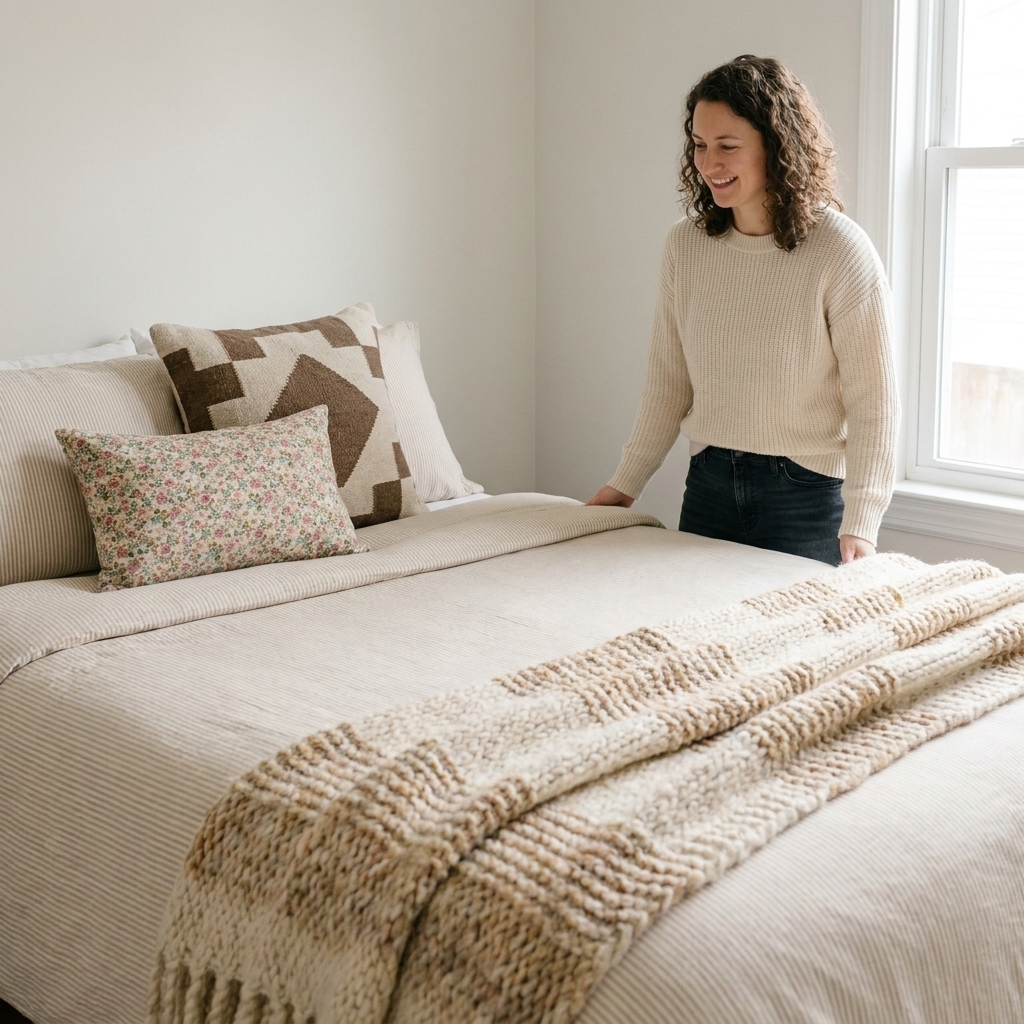
Decorative pillows can make a bed look instantly “finished” and also somehow instantly “chaotic” if the sizes feel off. The secret is not buying more pillows. It is choosing the right pillow types for your bed size, then stacking them in a repeatable order so it looks intentional every time you make the bed.
This guide breaks it down by bed size with foolproof formulas using the three workhorses of pillow styling: standard shams (your everyday sleep pillows dressed up), Euro shams (the big square pillows that create the back row and scream boutique hotel), and accent pillows (the fun layer that adds personality).
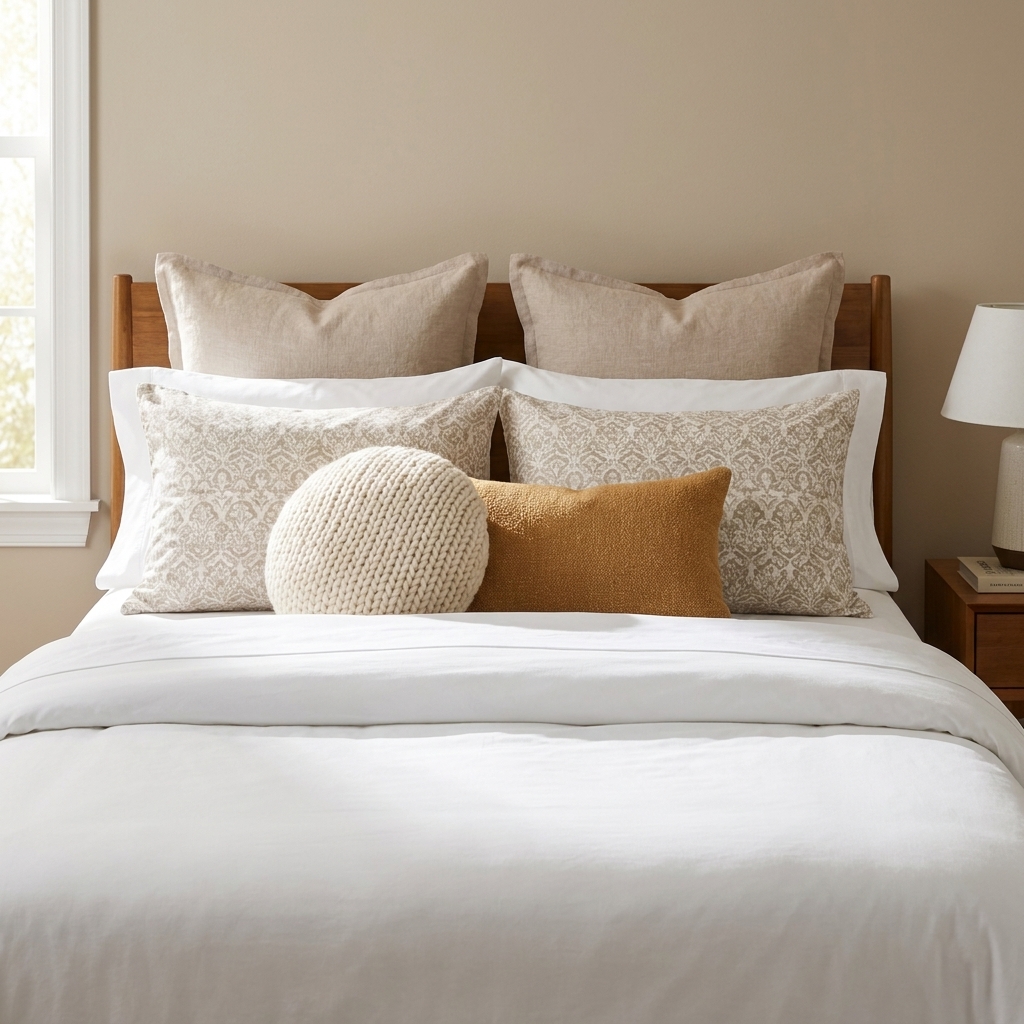
Pillow types and sizes
Before we talk layouts, here is the quick cheat sheet I use when I am thrift-shopping shams or trying to make a mismatched set look expensive. Sizes vary a little by brand, but these are the most common in the U.S.
- Standard pillows: typically 20 x 26 inches (sometimes 20 x 28).
- Queen pillows: typically 20 x 30 inches (a frequent point of confusion).
- King pillows: typically 20 x 36 inches (some run slightly shorter or longer).
- Standard sham: cover for a standard pillow (often with a flange or decorative edge).
- King sham: cover for a king pillow.
- Euro pillow: most commonly 26 x 26 inches (24 x 24 and 28 x 28 are also common).
- Accent pillows: common sizes are 18 x 18, 20 x 20, and 12 x 20 lumbar.
Sophie tip: If your shams look sad or slouchy, it is usually an insert issue, not a style issue. For a fuller, tailored look, you can size up inserts by about 1 inch, and sometimes 2 inches, when the sham and seams can handle it. If the cover is delicate, has a tight zipper, or you see strain at the corners, back down and start with +1.
The layering order
If you take nothing else from this article, take this: build from largest to smallest and back to front. That is what reads calm to the eye.
- Back row: Euros (or a “Euro look” alternative like two oversized square shams, or a third sham layered behind).
- Middle row: Standard or king shams (your sleeping pillows dressed up).
- Front row: Accent pillows (one lumbar, or two small squares, or one statement pillow).
From there, it is just scaling the count to your bed size and headboard width.
Twin bed
Twins are narrow, so the goal is “cozy and styled” without eating up the whole mattress. I love a Twin moment because it forces restraint in the best way.

Formula A: Classic Twin (3 pillows)
- 1 Euro sham (back, centered)
- 1 standard sham (front, centered)
- 1 lumbar accent (front, centered)
Why it works: It gives height and softness without looking like the bed is hiding under pillows.
Formula B: Cushy Twin (4 pillows)
- 1 Euro sham (back)
- 2 standard shams (slightly overlapped in front)
- 1 small accent (either a 12 x 20 lumbar or an 18 x 18 square)
When to use it: If your Twin has a wider headboard, or if it is a daybed situation where you want the “loungy” look.
Quick Twin proportion rule: Keep accent pillows to one (or at most two very slim ones). Too many small accents can start to look cluttered on a narrow mattress.
Full bed
Full beds are the awkward middle child in the best way. You have enough width to do a proper layered look, but you still need to keep it streamlined so it does not feel crammed.

Formula A: Hotel Full (5 pillows)
- 2 Euro shams (back row)
- 2 standard shams (middle row)
- 1 lumbar accent (front, centered)
Why it works: This is the easiest “it always looks right” setup for a Full. Balanced, symmetrical, and not fussy.
Formula B: Layered Full (6 pillows)
- 2 Euro shams
- 2 standard shams
- 2 small accents (two 18 x 18s, or one 18 x 18 plus one 12 x 20 lumbar)
Sophie tip: If you do two small accents, keep them in the same color family and vary texture instead. Think bouclé plus washed cotton, or velvet plus linen. That gives depth without visual noise.
Queen bed
Queens can handle the full, layered look you see in catalogs, but the trick is scaling so the bed still feels like a place to sleep, not a pillow showroom. If you share your bed, keep a “quick toss” plan in mind for bedtime.

Formula A: Everyday Queen (5 pillows)
- 2 Euro shams
- 2 standard shams
- 1 lumbar accent
This is my go-to. It is polished, fast to remake, and you are not wrestling a mountain of pillows at night.
Formula B: Styled Queen (7 pillows)
- 2 Euro shams
- 2 standard shams
- 2 square accents (18 x 18 or 20 x 20)
- 1 lumbar accent (front)
Placement: Put the two square accents slightly tucked in front of the standard shams, then center the lumbar across them.
Formula C: Big-Pillow Queen (6 pillows)
- 2 Euro shams
- 2 king shams (instead of standard)
- 2 small accents (or 1 lumbar if you want it simpler)
Why try it: King pillows on a Queen give that plush, “more expensive than it was” look, especially if your headboard is substantial. Just make sure the king shams do not overhang your nightstands visually.
King bed
King beds love structure. Because the mattress is wide, under-scaling your pillows can make the whole setup look oddly sparse, like you forgot to finish making the bed.
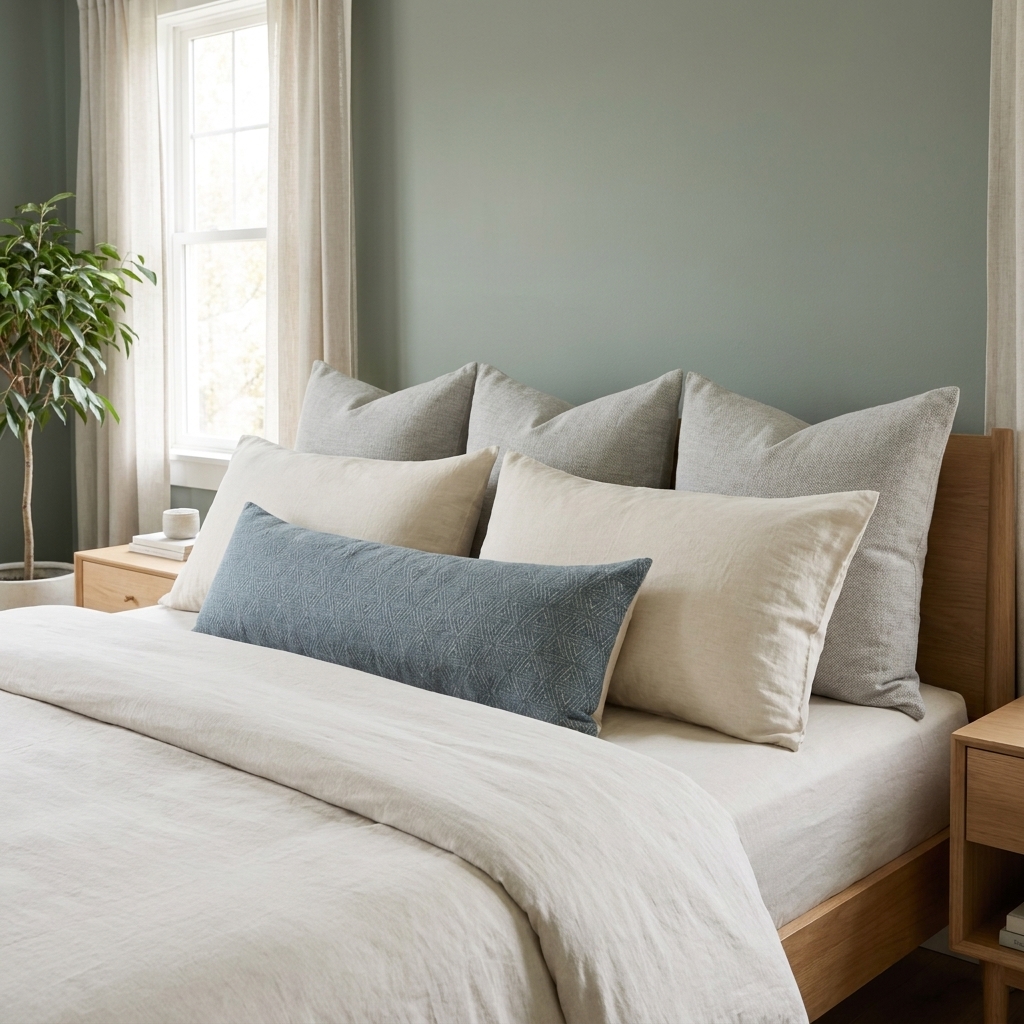
Formula A: Classic King (6 pillows)
- 3 Euro shams (back row)
- 2 king shams (middle row)
- 1 lumbar accent (front)
Why it works: Three Euros usually fill the width beautifully on a standard King and create that boutique-hotel backdrop. If your headboard is narrower or extra wide, adjust to two or three based on what looks proportional.
Formula B: Luxe King (8 to 9 pillows)
- 3 Euro shams
- 2 king shams
- 2 square accents (20 x 20 is gorgeous here)
- 1 lumbar accent (optional but very pretty)
Sophie reality check: If you hate moving pillows nightly, do the Luxe setup for photos or weekends, then keep a basket or bench nearby for easy storage.
Formula C: Minimal King (5 pillows)
- 2 Euro shams (slightly overlapped)
- 2 king shams
- 1 statement accent (a bold lumbar or one oversized square)
Best for: Very modern rooms, low headboards, or anyone who wants the bed to feel calm and not “done up.”
California King
California King beds are a little narrower and longer than a standard King, which means pillow spacing can look different. Start with the Classic King formula, then tweak the back row based on your headboard and nightstand placement.
- Most common Cal King win: 2 Euro shams + 2 king shams + 1 lumbar (a cleaner, less crowded look).
- If you love the full backdrop: 3 Euro shams can still work, especially with a wide headboard, but check that they do not feel jammed edge to edge.
Color and texture
My favorite pillow stacks have a simple formula: one solid, one subtle pattern, one texture. That is it.
- Solid: often your Euros or your main shams in a calming color.
- Subtle pattern: a stripe, small check, or a tiny floral that reads soft from across the room.
- Texture: linen, quilted cotton, velvet, bouclé, or a nubby woven that adds depth.
If you are working with thrifted finds (my people), unify them by repeating one color twice. Example: natural linen Euros + white shams + one accent pillow with both natural and white in the pattern.
Common issues
“My pillows slide down and look sloppy.”
Two usual culprits: slick fabric and underfilled inserts. Try fuller inserts and add a bit of friction by mixing in linen or cotton instead of all satin-like fabrics.
“My bed looks crowded.”
Downsize your front layer. Keep your back and middle layers, then do one lumbar instead of two accents. Also, check your Euros. On smaller beds, Euros can dominate fast.
“It looks flat, like a wall of pillows.”
Vary depths. Add a lumbar, choose a sham with a flange, or bring in one pillow with a chunkier texture to create shadow and dimension.
“My shams don’t match, but I want it to look intentional.”
Make it a set by repeating a color in at least two places and keeping the shapes consistent. Matching shapes reads organized, even when prints vary.
Quick reference
| Bed size | Easy everyday layout | More styled layout |
|---|---|---|
| Twin | 1 Euro + 1 standard + 1 lumbar | 1 Euro + 2 standard + 1 small accent |
| Full | 2 Euro + 2 standard + 1 lumbar | 2 Euro + 2 standard + 2 small accents |
| Queen | 2 Euro + 2 standard + 1 lumbar | 2 Euro + 2 standard + 2 square accents + 1 lumbar |
| King | 3 Euro + 2 king + 1 lumbar | 3 Euro + 2 king + 2 square accents + 1 lumbar |
| California King | 2 Euro + 2 king + 1 lumbar | 3 Euro + 2 king + 2 square accents + 1 lumbar |
FAQs
Do I need Euro shams?
No, but they are the easiest way to add height and a cozy, layered look. If you do not want Euros, you can mimic the effect with an extra set of larger square shams, or by layering a third sham behind your main two.
What is the difference between a pillowcase and a sham?
A pillowcase is meant for sleeping and is usually simple and envelope-style. A sham is a decorative cover, often with a flange, buttons, or a visible closure, meant to look finished on the bed. In real life, plenty of people sleep on pillows inside shams. It is your bed.
How many accent pillows are too many?
For most people, two accents plus a lumbar is the max before it starts feeling like bedtime work. If you love the look, keep a bench, basket, or trunk at the foot of the bed so you have an easy place to toss them.
Should my sleeping pillows be behind the shams?
If your standard or king shams are on your actual sleeping pillows, you are already set. If you prefer dedicated “pretty” inserts for shams, keep your sleeping pillows stacked behind them, or tuck sleeping pillows into the shams at night and strip them back off in the morning. There is no wrong answer, just what makes your routine easiest.
What is the simplest setup that still looks styled?
Two shams plus one lumbar on Full, Queen, or King. On a Twin, one sham plus one lumbar. Add Euros only if you want extra height.
Final rule
If you are stuck, do this: match your shams (standard, queen, or king), add Euros if your bed can handle them, then choose one accent pillow that makes you happy. A bedroom is a place to exhale. Your pillows should help, not demand a daily performance.